Angle Between Vectors
Theorem
For nonzero vectors , the angle between them satisfies .
Interpretation
The angle formula turns the algebraic inner product into geometry. Dividing by the Euclidean norms and removes the lengths and leaves only the information about direction, .
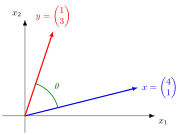
For the vectors drawn, , so . Two nonzero vectors are perpendicular when their inner product is zero and parallel when their angle is or .
In and the formula follows from the law of cosines in the triangle with sides , and . In with there is no picture to measure in, and the formula is used to define as the inverse cosine of the quotient. This definition makes sense because the Cauchy-Schwarz inequality guarantees that the quotient lies between and .
Because of the normalization, changing the length of one vector does not change the angle: replacing by doubles both and . A negative multiple is different: replacing by changes the sign of and turns into . Since the cosine is positive on and negative on , the sign of alone tells acute from obtuse.
The formula needs nonzero vectors. For the quotient is undefined and no angle is assigned, although makes the zero vector orthogonal to every vector.
Key Results
- If , the angle is acute.
- If , the angle is right and the vectors are orthogonal.
Examples
- and have angle .
- and have a positive inner product, so their angle is acute.
Prerequisites
Related Concepts
Sources
- Math II: Linear Algebra · Week 5
Aliases: angle between two vectors Keywords: vector angle Symbols: element of, pi, real numbers, square root, theta
Last updated: 20 October 2026 03:02
Angle Between VectorsInner ProductEuclidean NormOrthogonal VectorsCauchy-Schwarz InequalityEuclidean Space