Euler's Identity
Corollary
Setting in Euler's formula gives
Interpretation
Euler's identity is Euler's formula at the angle . For a real angle , is the point on the unit circle at angle , and is half a turn.
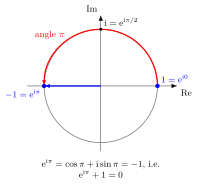
The red arc runs anticlockwise from through and ends at : since and , the imaginary part vanishes and . Adding to both sides gives .
Read as multiplication, the identity says that multiplying by is a half-turn about , that is, negation; two half-turns give . The identity is famous for joining the constants , , , and in one short equation, but mathematically it is just a special case of Euler's formula.
Key Results
- Euler's identity involves three basic arithmetic operations exactly once: addition, multiplication, and exponentiation.
- It also links five fundamental mathematical constants: the additive identity , the multiplicative identity , the fundamental circle constant , the base of the natural exponential , and the imaginary unit .
Examples
- Substitute into Euler's formula: . Adding gives . Thus multiplication by sends to , a half-turn about the origin.
Prerequisites
Related Concepts
Sources
- Math II: Linear Algebra · Week 1
Keywords: most beautiful formula Symbols: pi, theta
Last updated: 20 October 2026 03:02
Euler's IdentityEuler's FormulaComplex NumberPolar Representation of Complex NumbersDe Moivre's FormulaComplex ExponentiationComplex Exponential FunctionEuler's Number