Pivot
Definition
A pivot of a nonzero row is the first nonzero entry in that row.
Interpretation
A matrix arranges the coefficients into rows and columns; finding the first nonzero entry of a row identifies its pivot position and the corresponding column.
Pivots mark the leading variables and structure of an echelon form.
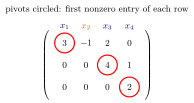
Blue columns hold a pivot: are basic (pivot) variables; the orange column has none: is a free variable, which can take any value, and the basic variables are then determined by it. In echelon form the number of pivots is the rank, and each pivot sits to the right of the one above.
Key Results
- In row echelon form, each pivot lies to the right of the pivot in the row above.
- In reduced row echelon form, every pivot is a leading and is the only nonzero entry in its column.
Examples
- In , the pivot is .
- In , the pivot is .
Prerequisites
Related Concepts
Sources
- Math II: Linear Algebra · Week 3
Aliases: pivot element, pivot entry Keywords: leading entry, leading coefficient
Last updated: 27 October 2026 11:52
PivotRow Echelon and Reduced Row Echelon FormMatrixGauss-Jordan EliminationElementary Row OperationRankLU Decomposition