Determinant
Definition
The determinant of a square matrix of size , denoted or , is the scalar defined recursively by for a matrix and, for ,
where is the matrix obtained from by deleting row and column (cofactor expansion along the first row). It detects invertibility and encodes the volume scaling of the associated linear transformation.
Interpretation
The determinant condenses a square matrix into one number that answers two questions at once: by what factor the linear map scales areas (in ) or volumes (in ), and whether the map can be undone. A nonzero determinant means exactly that is invertible.
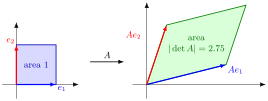
The unit square of area is mapped onto the parallelogram spanned by the columns and of . Its area is . A negative determinant would reverse the orientation, while a zero determinant would collapse the parallelogram to zero area and make the matrix singular.
The sign records orientation: swapping the two columns of turns into , the same area with the opposite sign. The product rule fits the picture too: applying and then scales areas first by one factor and then by the other.
In practice determinants are computed by cofactor expansion along a convenient row or column, or by Sarrus' rule for matrices. They give Cramer's rule for square systems, and the test whether a determinant is zero returns later in the course, when eigenvalues are computed.
A common slip is to treat the determinant as additive. In general : for the left side is and the right side is . Likewise for an matrix, not .
Key Results
- A square matrix is invertible if and only if .
- for square matrices of the same size.
Examples
- For , .
- .
Prerequisites
Related Concepts
- Inverse and Singular Matrices
- Matrix Product
- Affine Map
- Permutation
- Transformation of a Continuous Random Variable
Sources
- Math II: Linear Algebra · Week 4
- Math V: Advanced Linear Algebra · Week 1 (revisited)
Aliases: det, matrix determinant Symbols: real numbers, sum
Last updated: 20 October 2026 03:02
DeterminantCharacteristic PolynomialCofactor ExpansionCramer's RuleEigenvalue-Root TheoremSarrus' RuleMultivariable Inverse Function TheoremBasis of Solutions of a Difference EquationOrthogonal MatrixMatrixInverse and Singular MatricesMatrix ProductAffine MapPermutationTransformation of a Continuous Random Variable