Gauss-Jordan Elimination
Algorithm
Gauss-Jordan elimination is the algorithm that applies elementary row operations to an augmented matrix until it reaches reduced row echelon form.
Interpretation
Gauss-Jordan elimination solves linear systems by transforming them into equivalent systems whose solutions can be read off directly. It works column by column: create a pivot, use it to clear the entries below it, and finally clear the entries above the pivots as well.
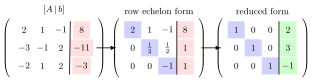
The forward elimination uses the row additions , , and . Scaling the pivots to and clearing the entries above them gives reduced row echelon form, from which can be read without back substitution. Stopping at row echelon form and then solving by back substitution is called Gaussian elimination.
The final reduced row echelon form shows the type of solution set. A row with means that there is no solution. Otherwise each column without a pivot gives a free variable that can be chosen as a parameter, and the solution is unique if and only if every column of the coefficient part has a pivot, as in the figure. If the entry in the pivot position is , a lower row with a nonzero entry in that column is swapped up first; if there is none, the column gets no pivot.
The same steps appear in OR Modelling: a simplex pivot divides the pivot row by the pivot and subtracts multiples of it from all other rows of the tableau, which is one Gauss-Jordan step.
Key Results
- Gauss-Jordan elimination preserves the solution set of the system.
- If the coefficient side of an augmented matrix becomes the identity matrix, the right side gives the unique solution.
Examples
- The system , , reduces to , , .
- Gauss-Jordan elimination can also be used to compute inverse matrices by augmenting with .
Prerequisites
Related Concepts
- Inverse and Singular Matrices
- Solution Set
- Equivalent Systems of Equations
- LU Decomposition
- Pivot
- Standard Form of a Linear System
Sources
- Math II: Linear Algebra · Week 3
Aliases: Gauss-Jordan reduction, Gauss-Jordan method Keywords: Gaussian elimination, row reduction
Last updated: 20 October 2026 03:02
Gauss-Jordan EliminationAugmented MatrixElementary Row OperationRow Echelon and Reduced Row Echelon FormInverse and Singular MatricesSolution SetEquivalent Systems of EquationsLU DecompositionPivotStandard Form of a Linear System