Diagonal Matrix
Definition
A diagonal matrix is a square matrix whose off-diagonal entries are all zero.
Interpretation
A diagonal matrix acts on each coordinate separately: multiplies the -th coordinate of by the -th diagonal entry and never mixes coordinates.
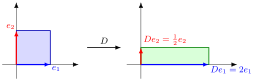
The matrix stretches to and shrinks to , so the unit square becomes a rectangle twice as wide and half as tall. The axes keep their directions, and the area is the product of the diagonal entries, the determinant.
Calculations reduce to calculations with numbers: products and powers are taken entry by entry on the diagonal, here , and a diagonal matrix is invertible if and only if no diagonal entry is , with the reciprocals as inverse. Zeros on the diagonal are allowed, so the zero matrix is diagonal too. Later in the course this simplicity is the reason to bring a matrix into diagonal form where possible.
Key Results
- The determinant of a diagonal matrix is the product of its diagonal entries.
- The product and sum of diagonal matrices of the same size are diagonal.
Examples
- is diagonal.
- and are diagonal.
Prerequisites
Related Concepts
Sources
- Math II: Linear Algebra · Week 5
Last updated: 20 October 2026 03:02
Diagonal MatrixDiagonalizationMatrixMatrix DiagonalsEigenvalue and EigenvectorTriangular MatrixBlock MatrixIdentity MatrixTrace