Countable and Uncountable Sets
Definition
A set is countably infinite if it has the same cardinality as the natural numbers, equivalently if there is a bijection between the set and
A set is countable if it is finite or countably infinite. A set that is not countable is called uncountable.
Course convention
In Math II: Linear Algebra, countable includes finite sets. Use countably infinite when the set must be infinite and in bijection with
Interpretation
A countable set is one whose elements can be listed as a first, a second, a third element and so on, with every element appearing somewhere. An uncountable set is too large for this: every sequence indexed by the natural numbers misses some of its elements.
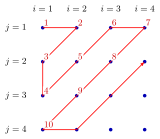
The figure lists pairs of positive integers along the diagonals on which is constant. The pair gets the number , the pairs and get and , and the diagonal with gets , and . Each diagonal is finite, so every positive-integer pair receives exactly one number. Here includes : subtracting from both coordinates and from every list label gives a bijection from to , including all pairs with a zero coordinate. Thus the product is countably infinite, although it looks larger than .
Repeated entries in a list can be skipped: reading as the fraction and skipping repeats such as , the zigzag lists every positive rational number; adding and the negatives shows that is countable. Uncountability is harder to show, since every possible list must fail: Cantor's diagonal argument builds, from any list of numbers in , a number not on it.
A common slip is to treat infinite and uncountable as the same. , and are infinite but countable, of size aleph null; is strictly larger and has the cardinality of the continuum.
Key Results
- Every finite set is countable.
- Every subset of a countable set is countable.
- , , and are countably infinite.
- Cantor's diagonal argument shows that and are uncountable.
Examples
- is countable because it is finite.
- The even natural numbers are countably infinite: gives a bijection from .
- The real interval is uncountable.
Prerequisites
Related Concepts
Sources
- Math II: Linear Algebra · Week 1
Aliases: countable set, uncountable set, uncountably infinite, at most countable Symbols: integers, natural numbers, rational numbers, real numbers
Last updated: 27 October 2026 11:52
Countable and Uncountable SetsCantor's Diagonal ArgumentDiscrete Random VariableCoverUnion and Intersection of Closed SetsUnion and Intersection of Open SetsCardinalityNatural NumberAleph NullCardinality of the ContinuumFinite and Infinite SetsInfinityContinuum Hypothesis