Vector Addition
Definition
Vector addition is the operation in a vector space that combines two vectors to produce another vector.
Interpretation
Vector addition combines two vectors of the same space into a third one. In coordinate spaces it is done coordinate by coordinate, , so it only makes sense for vectors with the same number of coordinates.
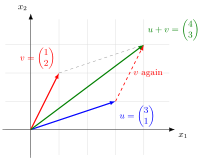
In the figure, and add to . Geometrically, is drawn again at the tip of , and runs from the origin to the end of this path: the tip-to-tail rule. It is also the diagonal of the parallelogram with sides and .
Going round the parallelogram the other way, first, ends at the same point: this is commutativity, . With associativity, the zero vector and the inverses , addition makes an Abelian group. In other vector spaces addition is whatever the space defines; for polynomials, coefficients of equal powers are added.
Key Results
- Vector addition is associative and commutative.
- The zero vector is the additive identity.
Examples
- In , .
Prerequisites
Related Concepts
Sources
- Math II: Linear Algebra · Week 2
Aliases: addition of vectors Symbols: real numbers
Last updated: 20 October 2026 03:02
Vector AdditionLinear CombinationSubspaceZero VectorVector SpaceMatrix AdditionVector