Eigenbasis
Definition
An eigenbasis is a basis of a vector space consisting entirely of eigenvectors of a linear operator.
Interpretation
An eigenbasis is a choice of coordinate directions in which the operator does nothing but stretch: each basis vector is sent to a multiple of itself. In an eigenbasis, the matrix of the operator is therefore diagonal, with the eigenvalues on the diagonal.
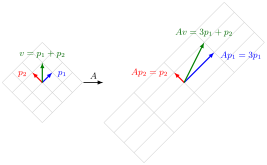
The left grid is drawn along the eigenvectors and of , with eigenvalues and . After applying , the grid is stretched three times in the direction and unchanged in the direction. The vector has coordinates in this basis and is sent to , with coordinates ; in this basis the matrix of is .
In general, if , then : each coordinate is multiplied by its own eigenvalue. Linear independence rules out several eigenvectors on one line, which cannot supply distinct coordinate directions, and the eigenvectors must span the whole space, so that every vector has such coordinates.
An eigenbasis exists exactly when the matrix is diagonalizable, and its vectors are the columns of in diagonalization. The distinct eigenvalues theorem guarantees one when an matrix has distinct eigenvalues. Not every matrix has one: the eigenvectors of the shear all lie on the horizontal axis.
An eigenbasis is not unique. Each eigenvector may be rescaled and the order may change, and for every basis is an eigenbasis.
Key Results
- A matrix is diagonalizable exactly when an eigenbasis exists.
- The change-of-basis matrix in diagonalization has eigenbasis vectors as its columns.
Examples
- The standard basis is an eigenbasis for a diagonal matrix.
- If two independent eigenvectors span , they form an eigenbasis.
Prerequisites
Related Concepts
Sources
- Math II: Linear Algebra · Week 6
Aliases: eigenvector basis, basis of eigenvectors Symbols: lambda, real numbers
Last updated: 20 October 2026 03:02
EigenbasisDiagonalizable MatrixDiagonalizationLinear Vector ODEBasisEigenvalue and EigenvectorLinear OperatorLinear Dependence and IndependenceDistinct Eigenvalues Theorem