Complex Reciprocal
Definition
The reciprocal of the complex number is defined as .
Interpretation
The reciprocal is the number that gives when multiplied by . Since the product of with its conjugate is , a positive real number for , dividing by the square of the modulus does this: .
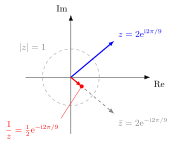
In the figure has length and angle ; its conjugate (dashed) has the same length and the angle , and dividing by shrinks it along the same ray to length . In general has the direction of and modulus , so points outside the unit circle are sent inside it and nonzero points inside are sent outside.
The condition is needed because for every . Every other complex number has a reciprocal, which is what makes a field, and dividing by means multiplying by (complex division). Reciprocals are not taken part by part: is , not .
Key Results
- We have and modulo . For the principal argument, unless is a negative real number, in which case both equal .
Examples
- The reciprocal of is .
Prerequisites
Related Concepts
Sources
- Math II: Linear Algebra · Week 1
Aliases: reciprocal of a complex number Symbols: complex numbers, pi
Last updated: 20 October 2026 03:02
Complex ReciprocalComplex DivisionComplex ConjugateComplex Absolute ValueComplex NumberComplex Multiplication