Skip to content

Transpose

Definition

The transpose of a matrix A=(aij)\boldsymbol{A}=(a_{ij}) of size m×nm\times n is the n×mn\times m matrix A⊤\boldsymbol{A}^{\top} whose entries are (A⊤)ij=aji(\boldsymbol{A}^{\top})_{ij}=a_{ji}.


Interpretation

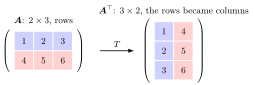
Transposition flips a matrix across its main diagonal: row ii of A\boldsymbol{A} becomes column ii of A⊤\boldsymbol{A}^{\top}, so an m×nm\times n matrix becomes an n×mn\times m matrix.

A 2 by 3 matrix and its 3 by 2 transpose, with each row of the matrix becoming a column of the transpose.

The rows (1,2,3)(1,2,3) and (4,5,6)(4,5,6) of the 2×32\times3 matrix become the two columns of the 3×23\times2 transpose. The entry 66 in position (2,3)(2,3) moves to position (3,2)(3,2), which is the rule (A⊤)ij=aji(\boldsymbol{A}^{\top})_{ij}=a_{ji}, while the diagonal entries 11 and 55 stay in place. Transposing twice gives the original matrix back.

The reversed order in (AB)⊤=B⊤A⊤(\boldsymbol{A}\boldsymbol{B})^{\top}=\boldsymbol{B}^{\top}\boldsymbol{A}^{\top} is forced by the sizes. If A\boldsymbol{A} is m×nm\times n and B\boldsymbol{B} is n×kn\times k, then B⊤A⊤\boldsymbol{B}^{\top}\boldsymbol{A}^{\top} is a (k×n)(n×m)(k\times n)(n\times m) product and is defined, while A⊤B⊤\boldsymbol{A}^{\top}\boldsymbol{B}^{\top} is a (n×m)(k×n)(n\times m)(k\times n) product, which is not defined unless m=km=k. Writing (AB)⊤=A⊤B⊤(\boldsymbol{A}\boldsymbol{B})^{\top}=\boldsymbol{A}^{\top}\boldsymbol{B}^{\top} is therefore a common slip.

Transposition turns a column vector into a row vector, which is how row vectors are usually written. A matrix is symmetric when A=A⊤\boldsymbol{A}=\boldsymbol{A}^{\top}. Later, the product x⊤y\boldsymbol{x}^{\top}\boldsymbol{y} of a row and a column becomes the dot product. Other texts write the transpose with a superscript capital T or with a prime; this wiki uses the ⊤\top symbol throughout.


Key Results

  • (A⊤)⊤=A(\boldsymbol{A}^{\top})^{\top}=\boldsymbol{A}.
  • (AB)⊤=B⊤A⊤(\boldsymbol{A}\boldsymbol{B})^{\top}=\boldsymbol{B}^{\top}\boldsymbol{A}^{\top} whenever the product is defined.

Examples

  • If A=(1234)\boldsymbol{A}=\begin{pmatrix}1&2\\3&4\end{pmatrix}, then A⊤=(1324)\boldsymbol{A}^{\top}=\begin{pmatrix}1&3\\2&4\end{pmatrix}.
  • The transpose of (123)\begin{pmatrix}1&2&3\end{pmatrix} is (123)\begin{pmatrix}1\\2\\3\end{pmatrix}.

Prerequisites

Sources

Aliases: matrix transpose, transposed matrix

Last updated: 20 October 2026 03:02