Function
Definition
A function assigns to every input exactly one output The phrase "exactly one" is essential: one input cannot be assigned two different outputs, although different inputs may share the same output.
Functions are also called maps. A function is specified by its domain, its codomain, and its assignment rule. Two functions with the same domain and codomain are equal, written if for every a formula alone therefore does not determine a function.
Interpretation
A function is a rule that answers one question for each allowed input: which output belongs to it? Every input receives exactly one answer, so the output is completely determined by the input.
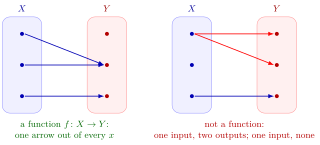
In the left diagram every point of has exactly one arrow leaving it. Two inputs share the middle output and the top point of is never reached; both are allowed. In the right diagram the top input has two arrows and the middle input has none, so the rule fails in both ways and does not define a function from to .
The definition therefore makes two demands on every : at least one output, so the rule must make sense on the whole domain, and at most one output. It demands nothing of the elements of . Whether every element of is reached, and whether it is reached only once, are separate questions, answered by surjectivity and injectivity.
A common slip is to identify a function with its formula. The rule on and the same rule on are different functions: the second is injective, the first is not, since . In the same way, denotes the function, while is a single number, its value at .
A sequence is itself a function: it assigns a term to each index . The idea returns in later courses too, for example as linear maps between vector spaces in Math II.
Key Results
Examples
- defined on the real numbers
- defined on
Prerequisites
Related Concepts
Sources
- Math I: Calculus · Lecture 4
Aliases: map, mapping Keywords: transformation Symbols: element of, infinity, real numbers, square root
Last updated: 20 October 2026 03:02
FunctionBounded FunctionCodomainComposition of FunctionsConstant FunctionConvexity and ConcavityDomainFloor and Ceiling FunctionsGlobal ExtremumGraph of a FunctionIdentity FunctionIndicator FunctionIntegrandLimit at a PointLimit at InfinityLocal ExtremumMonomial and Power FunctionMonotone FunctionPeriodic FunctionRange and ImageSignum FunctionTrigonometric FunctionsZero of a FunctionLinear MapFunction of a Random VariableProbability FunctionRandom VariableFunction between SpacesPointwise ConvergenceUniform ContinuityUniform ConvergenceBinding and Nonbinding ConstraintsConvex and Concave Functions on R^nExogenous and Endogenous VariablesLagrangian FunctionRestriction of a FunctionBest-Response CorrespondenceNormal-Form GameRational AgentReal NumberBijection and Inverse FunctionSequenceBinary OperationCantor's TheoremStochastic Process