Divergence to Infinity
Definition
Let be a function defined on some punctured neighbourhood of We say that diverges to positive infinity as and write if for every there exists such that
Similarly, we say that diverges to negative infinity as and write if for every there exists such that
Interpretation
Divergence to infinity describes functions whose values grow beyond all bounds near a given point. It is not a limit in the ordinary sense, since is not a real number: the notation records the particular way in which the limit fails to exist.
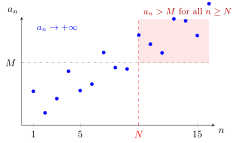
The figure shows the sequence version from the Key Results, with the index in the role of and in place of . For the level drawn, all terms from onwards lie in the shaded region above . A single early term above , here , is not enough, since and fall below again. The small wiggles do not matter, as long as such an exists for every level .
This modifies the definition of a limit at a point: instead of entering every small band about a finite value, the outputs must eventually exceed every real threshold, or fall below every threshold for negative divergence. The quantifiers work as in the - definition: the level is given first and is arbitrary, and may depend on it, typically shrinking as grows. For at , the choice works for every .
A common slip is to equate "unbounded" with "diverges to infinity". The sequence with for even and for odd is unbounded, yet it does not diverge to , because infinitely many terms stay at . Divergence to infinity, possibly one-sided, is what defines a vertical asymptote.
Key Results
- Divergence to infinity is a form of non-finite limit.
- Divergence may differ on one-sided neighbourhoods.
- A sequence diverges to written if for every there exists such that for all divergence to is defined with
Examples
Prerequisites
Related Concepts
Sources
- Math I: Calculus · Lecture 5
Aliases: infinite limit Keywords: diverge to infinity, diverges to infinity Symbols: delta, element of, epsilon, infinity, real numbers
Last updated: 20 October 2026 03:02
Divergence to InfinityVertical AsymptoteLimit at a PointOne-Sided LimitLimit at InfinityExtended Real NumberInfinity