Monotone Function
Definition
Let A function is called (monotonically) increasing or nondecreasing if for all and in such that one has Likewise, a function is called (monotonically) decreasing or nonincreasing if whenever then
A function is called strictly increasing if for all and in such that one has Likewise, a function is called strictly decreasing if whenever then
Interpretation
A monotone function preserves or reverses order. If is increasing, a larger input never gives a smaller output; if is decreasing, a larger input never gives a larger output. Monotonicity rules out oscillation and simplifies qualitative analysis.
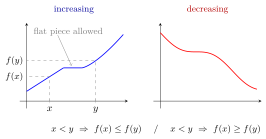
In the left panel the dashed lines compare and for , and indeed . The flat piece in the middle is allowed because the inequality in the definition is weak, but it is exactly what stops this function from being strictly increasing. The graph in the right panel only falls from left to right; it levels off for a moment near the middle but never stays flat, so the function is still strictly decreasing.
The definition compares any two inputs of , not only nearby ones, so it is a statement about the whole set . Terminology differs between texts: some use "increasing" for what this page calls strictly increasing, which makes "nondecreasing" the unambiguous word for . A constant function is both increasing and decreasing.
A common slip is to combine pieces. The function is decreasing on and on , but not on its whole domain: and yet .
A strictly monotone function is injective, so it has an inverse on its range; this is how logarithms invert exponential functions. Monotone sequences are the same notion for functions of the index . In probability, every cumulative distribution function turns out to be nondecreasing.
Key Results
- Monotone functions are injective on intervals where they are strictly monotone.
- Monotone functions may have jump discontinuities.
- Monotonicity constrains the derivative. Let be an interval, let be an interior point of and let be differentiable at If is nondecreasing on then if nonincreasing, then
- Sign test for strict monotonicity. Let be continuous on an interval and differentiable on its interior. If throughout the interior, then is strictly increasing on if strictly decreasing; if constant. This is proved from the mean value theorem.
- Characterization on an open interval. For differentiable on an open interval is nondecreasing on if and only if on and nonincreasing if and only if
- For strict monotonicity only one implication survives: everywhere implies strictly increasing, but the converse fails, since is strictly increasing on with
Examples
- The function is strictly increasing on
- The signum function is monotone but not strictly monotone.
Prerequisites
Related Concepts
Sources
- Math I: Calculus · Lectures 4 and 7
Aliases: monotonic function Keywords: increasing function, decreasing function Symbols: infinity, real numbers, subset
Last updated: 20 October 2026 03:02
Monotone FunctionIntegral Test for ConvergenceFunctionMonotone SequenceInjective FunctionMean Value TheoremCumulative Distribution Function