Length of an Interval
Definition
For a bounded interval represented by or where are real numbers, we define the length of denoted by as If is a singleton set or the empty set, then
Interpretation
The length of an interval measures how much of the real line it covers. For a bounded interval it is the distance between the endpoints, so it depends only on where the interval starts and ends.
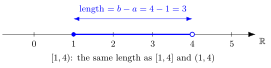
The figure shows the half-open interval : the filled dot at belongs to it, the open dot at does not, and the arrow above marks its length . The intervals and have the same length: is together with the single point , and a singleton has length .
The notation echoes the absolute value: since , , the distance from to . Lengths are the widths of the rectangles in a Riemann sum, and over a partition of the lengths of the subintervals add up to .
A common slip is to count points instead of measuring: contains the four integers , but its length is , and it contains infinitely many real numbers.
Key Results
- The length depends only on the endpoints.
- Singletons and empty sets have length zero.
Examples
- The interval has length
- The interval has length
Prerequisites
Related Concepts
Sources
- Math I: Calculus · Lecture 10
Aliases: interval length
Last updated: 20 October 2026 03:02
Length of an IntervalPartition of an IntervalEndpoint and Bounded IntervalSingleton SetEmpty SetRiemann SumInterval