Integer
Definition
The integers are the positive and negative whole numbers together with zero:
Every natural number is an integer, so Math I: Calculus takes and its usual arithmetic and order as given.
Interpretation
Integers extend the natural numbers by introducing additive inverses . They make subtraction unrestricted: for example, the equation has no solution in but has the integer solution .
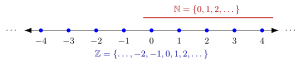
On the number line the integers are equally spaced points, one unit apart, continuing without end in both directions. The bracket marks , the integers from upwards; the points to the left of are the negatives that adds. There is no integer strictly between two neighbouring integers.
Division remains restricted, since is not an integer; removing this limitation is the step to the rational numbers. A common slip concerns the convention for : here , so the positive integers are , not all of .
Key Results
- Every integer is exactly one of the following: zero, a positive natural number, or the negation of a positive natural number.
- The set is closed under addition, subtraction, and multiplication, but not under division.
- Every integer has a unique additive inverse satisfying
- For integers and we have exactly when for some positive natural number
Examples
- and are integers.
- is not an integer.
- The difference is an integer.
Prerequisites
Related Concepts
Sources
- Math I: Calculus · Lecture 2
Symbols: element of, integers, natural numbers, subset
Last updated: 20 October 2026 03:02
IntegerFloor and Ceiling FunctionsNegationRational NumberSequenceNatural NumberSubtraction and DifferenceAddition and Sum