Surjective Function
Definition
A function is surjective if for every there exists an such that In other words, a function is onto if its codomain is exactly its range.
Interpretation
Surjectivity describes how completely a function covers its codomain: every element of must be the output of at least one input, so no element of the codomain is left unused.
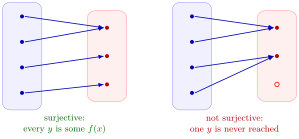
In the left diagram each of the three points of receives at least one arrow, the top one even two, so the function is surjective; sharing an output is allowed. In the right diagram the bottom point of , drawn hollow, receives no arrow, so that function is not surjective, even though every input is used.
To prove surjectivity, take an arbitrary and find an with , usually by solving this equation for . For on the solution is . To disprove it, a single without a solution suffices, as shows for on . In terms of the range, is surjective if and only if its range equals ; for a function on a subset of , every horizontal line with must meet the graph at least once.
Surjectivity is a property of the rule together with the codomain: with codomain instead of , the function becomes surjective. Together with injectivity it makes a bijection: surjectivity guarantees at least one solution of , injectivity at most one.
A common slip is to check the inputs instead of the outputs. That every input has an output is true for every function; surjectivity is about every element of the codomain.
Key Results
- A function is surjective if every element of the codomain is attained.
- Surjectivity depends on both the function rule and the chosen codomain.
- Changing the codomain may change surjectivity.
Examples
- The function from to is surjective.
- The function from to is not surjective.
Prerequisites
Related Concepts
Sources
- Math I: Calculus · Lecture 4
Aliases: onto function, surjection, surjective Symbols: element of, infinity, real numbers, square root
Last updated: 20 October 2026 03:02
Surjective FunctionBijection and Inverse FunctionLocal Injectivity, Surjectivity, and BijectivityCodomainRange and ImageInjective Function