Bounded Function
Definition
Let and let be a function. We say that is bounded from above if there exists a real number such that for all We say that is bounded from below if there exists a real number such that for all We say that is bounded if there exists a real number such that for all we say that is unbounded in the absence of such a real number
Interpretation
A bounded function is one whose values remain within fixed upper and lower bounds throughout its domain: its graph fits in a horizontal strip of finite width.
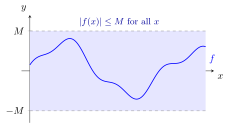
The graph oscillates, but it never leaves the shaded band between and ; this is the condition for all . One number works for the whole domain. The function need not touch the edges of the band, and any larger would do as well.
The three notions in the definition fit together: is bounded if and only if it is bounded from above and from below, since for all gives . Boundedness depends on the domain: is unbounded on , but bounded on , where . In terms of sets, is bounded exactly when its range is a bounded set, and then the range has a supremum and an infimum.
A common slip is to expect a bounded function to reach its bounds. The function on is bounded by , but no value equals and no value is the largest. Later, the extreme value theorem gives conditions under which a largest value is attained.
Key Results
- If a function is bounded, then its range is a bounded set.
- Continuous functions on closed and bounded intervals are bounded.
- Boundedness is preserved under addition and multiplication by a constant.
Examples
- is bounded on
- is not bounded on
Prerequisites
Related Concepts
Sources
- Math I: Calculus · Lecture 4
Symbols: element of, infinity, real numbers, subset
Last updated: 20 October 2026 03:02
Bounded FunctionRiemann SumUniform NormFunctionUpper BoundLower BoundBounded SetBounded SequenceSupremumInfimumExtreme Value Theorem