Riemann Sum
Definition
Let be a bounded function. Given a partition of and a tag in each subinterval, the corresponding Riemann sum is
where the tags may be chosen independently of one another.
Interpretation
A Riemann sum approximates the area under the graph of by rectangles. On each subinterval of a partition it places a rectangle of width and height , the value of at the chosen tag, and adds up their areas in a finite sum.
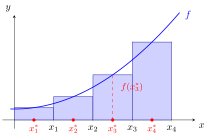
Here on with , and the tags are the midpoints. The rectangle heights are , so the shaded area is , close to the area under the curve.
Each term is height times width, and the sum depends on two choices: the cut points and the tags. The tags matter: for this increasing , the left tags give and the right tags give , which bracket the true area. Where is negative the terms are negative, so a Riemann sum approximates signed area: parts below the axis count negatively.
Riemann sums are the bridge between sums and integrals: the Riemann integral is defined as their limit, and conversely an integral can be estimated numerically by a Riemann sum with many pieces. A common slip on a regular subdivision of into pieces is to take the width as . It is , which equals only when .
Key Results
- Riemann sums depend on both the partition and the choice of tags
- On a regular subdivision, the tag gives the left Riemann sum and gives the right Riemann sum.
-
Because is bounded, each subinterval has a finite supremum and infimum, so we may also form the upper and lower Riemann sums
which bracket every tagged Riemann sum on the same partition. These exist even when the extreme values are not attained. - As the mesh shrinks, the Riemann sums of an integrable function approach its integral, whatever tags are chosen. A single refinement need not improve a particular tagged sum, but it never raises the upper sum and never lowers the lower sum.
Examples
- For on with the regular subdivision into pieces, the left Riemann sum is and the right Riemann sum is the integral lies between them.
Prerequisites
Related Concepts
Sources
- Math I: Calculus · Lecture 10
Symbols: element of, integral, real numbers, sum
Last updated: 27 October 2026 11:52
Riemann SumRiemann IntegralBounded FunctionPartition of an IntervalFinite SeriesDefinite IntegralLength of an Interval