Punctured Neighbourhood
Definition
Let and let
The point is a limit point of if, for every there is an with If is not a limit point of it is an isolated point of
For the set is a neighbourhood of Removing itself gives the punctured neighbourhood of which is any set of the form
for some
Interpretation
A punctured neighbourhood describes the points arbitrarily close to a given point while excluding itself. It is the set of inputs that a limit at a point looks at, so local behaviour near can be studied without evaluating the function at .
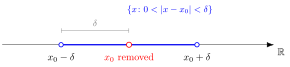
In the figure the radius is : the punctured neighbourhood is , an open interval about with its centre removed. The absolute value expresses distance from the centre; excludes the centre and keeps the point inside the interval.
In these terms, is a limit point of when every punctured neighbourhood of contains a point of . This is exactly what " within " needs, and itself need not belong to : is a limit point of , so makes sense for a function defined on . By contrast, every integer is an isolated point of , since contains no integer; for a function defined only on the limit at a point is therefore not defined at all, and only the limit as of a sequence remains.
Limit points return in Math III under the name accumulation points, defined in the same way for more general sets.
Key Results
- The definition of a limit at a point requires to be a limit point of the domain, which is exactly what makes " approaches " meaningful.
- The limit laws for functions are stated for functions defined on a punctured neighbourhood of
- Excluding the centre point avoids any reliance on the value
- A function is never differentiable at an isolated point of its domain.
Examples
- is a punctured neighbourhood of the origin.
- Every point of is a limit point of and so is every point of
- is an isolated point of
Prerequisites
Related Concepts
Sources
- Math I: Calculus · Lecture 5
Aliases: punctured neighborhood, deleted neighbourhood, deleted neighborhood Keywords: limit point, isolated point, neighbourhood Symbols: delta, element of, infinity, integers, real numbers, subset, union
Last updated: 20 October 2026 03:02
Punctured NeighbourhoodLimit at a PointSetIntervalAbsolute ValueOne-Sided Limit