Accumulation Point in a Metric Space
Definition
Let be a metric space and let . A point is called an accumulation point (or cluster point, limit point) of if every metric ball around contains a point of different from , i.e.,
Let be a metric space and let be a sequence in . A point is called an accumulation point (or cluster point) of if, for every , there exist infinitely many such that , i.e., for every ,
Interpretation
An accumulation point of a set is a location you can approach arbitrarily closely using other points from the set. For a sequence, it is a point to which the sequence returns again and again: however small the ball around it, infinitely many terms lie in that ball.
Both definitions ask something of every , so only small balls matter. For a set, the words "different from " rule out counting itself, and need not belong to : for in , every point of is an accumulation point, including and . For a sequence, indices are counted, not distinct values. The constant sequence has as an accumulation point, although the set of its terms has none.
The accumulation points of a sequence in a metric space are exactly the limits of its convergent subsequences, which is the form in which they appear in the Bolzano-Weierstrass theorem. For a bounded real sequence, the limit superior and limit inferior are its largest and smallest accumulation points. The accumulation points of a set are what a closed set must contain: a set is closed if and only if it contains all its accumulation points, and its closure is the set together with them.
A common slip is to treat a single accumulation point as a limit. The sequence has as its only accumulation point, yet it does not converge, because it is unbounded.
Key Results
- A limit point can be characterized as an adherent point that is not an isolated point (a point such that some ball meets only in ).
Examples
- For , the only accumulation point is . Each point is isolated.
- The sequence has accumulation points 1 and -1. It does not converge.
-
Consider the sequence that is defined by . We can show that any number is an accumulation point of this sequence.
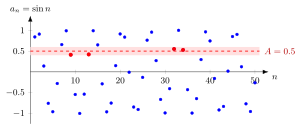
Among the first terms, four lie in the band (red); infinitely many terms fall in every band around , so is an accumulation point.
Prerequisites
Related Concepts
Sources
- Math III: Analysis · Lecture 9
Aliases: cluster point, limit point, subsequential limit Symbols: element of, epsilon, for all, infinity, intersection, natural numbers, real numbers, subset
Last updated: 20 October 2026 03:02
Accumulation Point in a Metric SpaceOpen Metric BallLimit Superior and Limit InferiorAdherent Point and Closure of a SetConvergence in a Metric Space