Sequentially Compact Set
Definition
Let be a metric space. A subset of is termed sequentially compact if for every sequence with each there exists a convergent subsequence that converges to a point
Interpretation
A set is sequentially compact if every sequence drawn from it has a subsequence that converges to a point still inside the set. Sequences in the set cannot escape, neither to infinity nor to a missing point at its edge.
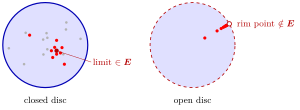
In the closed disc, the red subsequence converges to a point of . In the open disc, the illustrated sequence approaches a missing rim point, and every subsequence has that same limit outside , so the open disc is not sequentially compact.
Two requirements are packed into the definition: a convergent subsequence must exist, and its limit must lie in . The first fails for unbounded sets, as in shows; the second fails for sets that are not closed, as for the open disc. The whole sequence need not converge: in does not, but its even-indexed terms do.
In , the Bolzano-Weierstrass theorem shows that the sequentially compact sets are exactly the closed and bounded ones. In every metric space, sequential compactness is equivalent to compactness, so either description can be used. Sequences are often more convenient in proofs, such as showing that a continuous function attains its maximum, while the definition with open covers also makes sense where no metric is available.
A common slip is to think of sequential compactness as being "closed under limits". That describes closed sets, and it is not enough: is closed, but has no convergent subsequence.
Key Results
- In any metric space, a set is compact if and only if it is sequentially compact. This gives two equivalent ways to think about compactness: open covers or convergent subsequences.
Examples
- The closed unit ball is sequentially compact. This fails in infinite dimensions.
- Any finite set in any metric space is sequentially compact: some point is taken by infinitely many terms of a sequence in it, which gives a constant subsequence.
Prerequisites
Related Concepts
Sources
- Math III: Analysis · Lecture 9
Keywords: sequential compactness Symbols: element of, infinity, real numbers
Last updated: 20 October 2026 03:02
Sequentially Compact SetBolzano Weierstrass TheoremConvergence in a Metric SpaceSubsequenceCompact Set