Continuity between Metric Spaces
Definition
Consider two metric spaces and and a function where Let Assume there exists an such that We say that is continuous at if, for any there exists a such that whenever we have
We say that is continuous on (or simply continuous) if it is continuous at every point of At a point that has no such ball inside (a boundary point of ), the same condition is required only for
The condition says that the intersection of the domain with a sufficiently small open metric ball around is mapped into the -ball around . With the usual real distance , this is the familiar definition of continuity.
Interpretation
A function is continuous at a point if you can make the outputs as close as you want to the value at that point by taking inputs sufficiently close to it. In metric spaces, "close" is measured by the metrics: for the inputs and for the outputs.
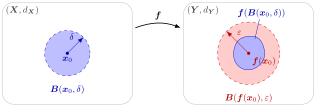
On the left is the open ball in ; on the right, its image lies entirely inside the ball in . This inclusion is the definition restated: every with satisfies . The order of choice matters. The tolerance on the outputs comes first, and is chosen in response; a smaller usually forces a smaller .
The may depend on both and the point . If one works at all points at once, has the stronger property of uniform continuity, known from real functions. The bound only keeps the -ball inside the domain , so that is defined there.
With and the distance , this is the - continuity of Math I. Continuity depends on the metrics: if carries the discrete metric, every function on is continuous, because . Descriptions by sequences and by preimages of open sets are given in the equivalent formulation of continuity.
A common slip is to fix first and then look for an . That reversed condition holds for every bounded function, including the discontinuous signum function at , where works for every .
Key Results
- If tends to two different values as approaches in two different ways (for example along two different lines, or along two sequences converging to ), then the limit of the function at that point does not exist, so the function is not continuous there. More generally, if for some sequence the values do not tend to then is not continuous at
- A vector-valued function into with its usual Euclidean metric is continuous if and only if each real component function is continuous.
- Most properties of real-valued functions of one real variable are preserved under continuity. In particular, continuity is preserved under addition, subtraction, multiplication, division (where the denominator is nonzero), as well as taking the maximum, minimum, and composition of functions.
Examples
- on . At , if you want within of , choose . Then gives .
Prerequisites
Related Concepts
Sources
- Math III: Analysis · Lecture 8
Symbols: delta, element of, epsilon, real numbers, square root, subset
Last updated: 20 October 2026 03:02
Continuity between Metric SpacesEquivalent Formulation of ContinuityExtreme Value Theorem on Compact SetsIntermediate Value Theorem on Connected SetsPath in a Metric SpaceTwice Continuous Differentiability on R^nOpen Metric BallContinuityUniform Continuity between Metric Spaces