Image and Preimage of a Set
Definition
Let and be sets (in this course usually subsets of metric spaces), and let be a function. Let be a subset of the domain , the image of under is defined as:
Let be a subset of the codomain , the preimage of under includes all points in the domain that give results in :
Interpretation
The image pushes a set of inputs forward: collects the outputs obtained from inputs in . The preimage pulls a set of outputs back: collects all inputs whose output lands in .
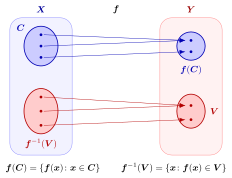
The three marked points of are sent to only two points of , so this is not injective. Going back, contains every point of that is mapped into , wherever it lies in .
A common slip is to read as requiring an inverse function. The preimage is defined for every function. For on , and . Only for a bijection does coincide with the image of under the inverse function. The same shows that the inclusions in the Key Results can be strict: for we get , and for we get .
Preimages behave well with set operations: they preserve unions, intersections and complements. Images preserve unions, but in general only holds.
The range of is the image of the whole domain, and a level set is the preimage of a single value. In probability, the event generated by a random variable and a set is the preimage of under the random variable.
This idea returns later: continuity can be characterized by preimages of open sets being open, whereas images of open sets need not be open.
Key Results
- only needs to be a part of the codomain of . This means there might be some in that doesn't match any in the domain .
- We have and .
Examples
- Let be . Image of the unit square under is . Preimage of under is the line .
- Let be . Image of the disc under is . Preimage of under is the vertical strip .
Prerequisites
Related Concepts
Sources
- Math III: Analysis · Lecture 7
Keywords: image of a set, preimage, inverse image Symbols: element of, intersection, real numbers, subset
Last updated: 22 October 2026 19:04
Image and Preimage of a SetEquivalent Formulation of ContinuityLevel Set and Level CurveDomainCodomainRange and ImageBijection and Inverse FunctionGenerated Event