Uniform Continuity between Metric Spaces
Definition
Consider metric spaces and , and a function . We say is uniformly continuous on if, for any , there exists a such that for all with , it holds that .
Interpretation
Uniform continuity asks for one that works at every point of at once: inputs within of each other, wherever they lie, have outputs within of each other. This is the general form of uniform continuity, with possibly different metrics on different spaces.
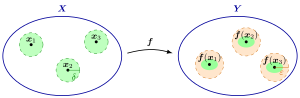
For a given , the three green balls in all have the same radius , and each is mapped inside the -ball around its centre's image. The same serves at every other point of .
The difference from continuity lies in the order of the quantifiers. For continuity, is chosen after the point and may depend on it; for uniform continuity, depends on alone. Every uniformly continuous function is therefore continuous, but not conversely. The function on is continuous, yet for no works: for the points and are less than apart, while .
Compactness removes the difference: a continuous function on a compact set is uniformly continuous, as the Key Results state, and for this is the Heine-Cantor theorem. Uniform continuity is what is needed when one estimate must hold over a whole domain, for example in the proof that a continuous function on is Riemann integrable.
A common slip is to speak of uniform continuity at a point. Uniform continuity is a property of a function on a set, since it compares all pairs of points of that set; at a single point there is only continuity.
Key Results
- Any continuous function defined on a compact set is uniformly continuous.
Examples
- Every constant function is uniformly continuous regardless of the metrics.
- Every function from a discrete space is uniformly continuous.
Prerequisites
Related Concepts
Sources
- Math III: Analysis · Lecture 9
Symbols: delta, element of, epsilon
Last updated: 20 October 2026 03:02
Uniform Continuity between Metric SpacesMetric and Metric SpaceUniform ContinuityContinuity between Metric Spaces