Partial Derivative
Definition
Let and consider a function . For an interior point of and an integer , the partial derivative of with respect to the -variable at , denoted by , is given by
where represents the unit vector in the positive direction of the -th coordinate, provided the limit exists.
The partial derivative changes only the th coordinate, so it is the Directional Derivative along the coordinate vector when the corresponding two-sided limit exists.
Interpretation
The partial derivative measures how the function changes when you nudge only one coordinate while keeping all others fixed. It is an ordinary derivative of the one-variable function at , as the second line of the Definition shows.
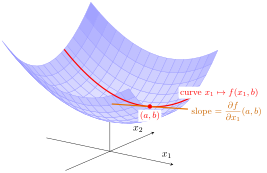
The vertical plane cuts the graph of in the red curve , which is the graph of a function of alone. Its tangent line at has slope . Cutting with the plane instead gives a curve in the -direction, and its slope at is .
In practice, one treats every other variable as a constant and differentiates with the one-variable rules, as in the Example. For a vector-valued , the partial derivative is a vector in , computed component by component. These vectors are the columns of the Jacobian matrix, and for a real-valued the partial derivatives form the gradient.
A common slip is to expect partial derivatives to describe the function in every direction. They only look along the coordinate axes. The function with for and vanishes on both axes, so both partial derivatives at the origin are . Yet it is not even continuous there, since for every . Existence of partial derivatives is therefore weaker than total differentiability; the Key Results give a sufficient condition, continuity of the partial derivatives, that closes the gap.
Key Results
- The partial derivative exists if and only if both and exist and are negatives of each other. In such a scenario, we have
- If is totally differentiable at then for every unit vector we have Without total differentiability this can fail even when all partial derivatives exist.
- If all the partial derivatives are both existent within a neighbourhood and continuous at the centre, then is totally differentiable at this point.
Examples
- The partial derivative of with respect to the first variable is
Prerequisites
Related Concepts
Sources
- Math III: Analysis · Lecture 12
Aliases: partial differentiation Symbols: partial, real numbers, subset, sum
Last updated: 22 October 2026 19:04
Partial DerivativeGradientHigher-Order Partial DerivativeSecond-Order Partial DerivativeTwice Continuous Differentiability on R^nCournot DuopolyDirectional DerivativeTotal Derivative as a Linear Map