Skip to content

Ratio Test

Proposition

Consider the series ∑n=1∞an\displaystyle \sum_{n=1}^\infty a_n where an∈Ra_n\in\mathbb{R} and an≠0a_n\ne0 for all sufficiently large nn. Let L=lim⁡n→∞∣an+1an∣\displaystyle L=\lim_{n \to \infty} \left| \dfrac{a_{n+1}}{a_n} \right| when this limit exists (possibly as +∞+\infty). Then:

  • If L<1,L < 1\text{,} the series converges. Moreover, ∑n=1∞∣an∣\displaystyle \sum_{n=1}^\infty |a_n| also converges.
  • If L>1,L > 1\text{,} the series diverges.
  • If L=1L = 1 or the limit does not exist, the test is inconclusive.

Interpretation

The ratio test compares a series with a geometric series. If consecutive terms eventually shrink by a factor close to L<1L<1, the terms decay at least as fast as a geometric sequence with a ratio between LL and 11, and the series converges absolutely. If L>1L>1, the terms eventually grow in absolute value, so they do not tend to 00 and the series diverges.

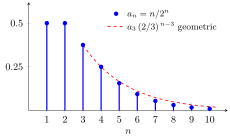
Terms n over 2 to the n, shrinking as n grows, below a geometric sequence with ratio 2/3 that bounds them from n = 3 on.

The figure shows an=n/2na_n=n/2^n. Here an+1an=n+12n→L=12<1\dfrac{a_{n+1}}{a_n}=\dfrac{n+1}{2n}\to L=\tfrac{1}{2}<1. For n≥3n\ge3, an+1≤23ana_{n+1}\le\tfrac{2}{3}a_n, so an≤a3(23)n−3a_n\le a_3(\tfrac{2}{3})^{n-3}: the dashed geometric curve lies above the terms from n=3n=3 on, and ∑an\displaystyle \sum a_n converges by comparison.

The test only looks at the limit LL, so the case L=1L=1 gives no information: the Examples show that ∑n1/n\displaystyle \sum_n1/n diverges and ∑n1/n2\displaystyle \sum_n1/n^2 converges, and both have L=1L=1. The test also says nothing when the limit does not exist; the root test then often still works, and whenever the ratio limit exists, the root test gives the same LL.

Applied to a power series, the ratio of consecutive terms is ∣cn+1cn∣∣x−a∣\left|\dfrac{c_{n+1}}{c_n}\right||x-a|, which tends to ∣x−a∣/R|x-a|/R with R=lim⁡n→∞∣cn/cn+1∣R=\lim_{n\to\infty}|c_n/c_{n+1}|. The series converges for ∣x−a∣<R|x-a|<R and diverges for ∣x−a∣>R|x-a|>R, which is how the Key Result finds the radius of convergence. Ratios are convenient for terms with factorials and powers, as in ∑nxn/n!\displaystyle \sum_n x^n/n!.

A common slip is to conclude convergence because every ratio is below 11. For the harmonic series, an+1/an=n/(n+1)<1a_{n+1}/a_n=n/(n+1)<1 for every nn, yet the series diverges: the ratios tend to 11, so they are not bounded by a fixed number below 11.


Key Results

  • For the power series ∑n=0∞cn(x−a)n\displaystyle \sum_{n=0}^\infty c_n (x - a)^n with eventually nonzero coefficients, the radius of convergence RR can be found using R=lim⁡n→∞∣cncn+1∣\displaystyle R = \lim_{n \to \infty} \left| \dfrac{c_{n}}{c_{n+1}} \right| if the limit exists or tends to infinity.
Examples

  • ∑n=1∞nen\displaystyle \sum_{n=1}^\infty \frac{n}{\mathrm{e}^n} is convergent since L=lim⁡n→∞∣(n+1)/en+1n/en∣=1e<1.\displaystyle L=\lim_{n \to \infty} \left| \dfrac{(n+1)/\mathrm{e}^{n+1}}{n/\mathrm{e}^n} \right| =\dfrac{1}{\mathrm{e}}<1\text{.}
  • ∑n=1∞2nn\displaystyle \sum_{n=1}^\infty \frac{2^n}{n} diverges since L=lim⁡n→∞∣2n+1/(n+1)2n/n∣=2>1.\displaystyle L=\lim_{n \to \infty} \left| \dfrac{2^{n+1}/(n+1)}{2^n/n} \right| =2>1\text{.}
  • When L=1,L=1\text{,} both convergent and divergent series exist, e.g., ∑n=1∞1n\displaystyle \sum_{n=1}^\infty \frac{1}{n} diverges while ∑n=1∞1n2\displaystyle \sum_{n=1}^\infty \frac{1}{n^2} converges.
  • ∑n=0∞xnn!\displaystyle \sum_{n=0}^\infty \frac{x^n}{n!} converges for all x∈Rx\in\mathbb{R} since R=lim⁡n→∞∣(n+1)!n!∣=+∞.\displaystyle R=\lim_{n \to \infty} \left| \dfrac{(n+1)!}{n!} \right|=+\infty\text{.}
  • ∑n=0∞2n(x−3)n\displaystyle \sum_{n=0}^\infty 2^n(x-3)^n converges for ∣x−3∣<1/2|x-3|<1/2 since R=lim⁡n→∞∣2n2n+1∣=12.\displaystyle R=\lim_{n \to \infty} \left| \dfrac{2^{n}}{2^{n+1}} \right|=\dfrac{1}{2}\text{.}
  • ∑n=0∞n!(x+1)n\displaystyle \sum_{n=0}^\infty n!(x+1)^n diverges for all xx except x=−1x=-1 since R=lim⁡n→∞∣n!(n+1)!∣=0.\displaystyle R=\lim_{n \to \infty} \left| \dfrac{n!} {(n+1)!}\right|=0\text{.}

Prerequisites

Sources

Aliases: d'Alembert's ratio test, D’Alembert’s ratio test Symbols: element of, infinity, real numbers, sum

Last updated: 20 October 2026 03:02