Gradient
Definition
Let , and let be a real-valued function. If is an interior point of and all first partial derivatives exist there, the gradient of at is given as the -dimensional column vector:
Interpretation
The gradient collects the first partial derivatives of a real-valued function into one vector. For a totally differentiable it points in the direction in which increases fastest, and its length is that fastest rate of increase.
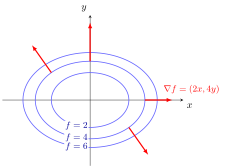
The figure shows level curves of for the values , and , with . The arrows start at four points of the level curve , such as and ; each is perpendicular to that curve and points outwards, towards larger values of . The gradients there are and : rises faster along the -axis, where the level curves lie closer together.
When , we say that is a stationary point of (possibly a local extremum point). At an interior local extremum every partial derivative that exists is , but a stationary point need not be an extremum: has , yet takes both larger and smaller values than near the origin.
When is totally differentiable at and , the gradient gives two things: the direction of steepest ascent, and the maximal rate of increase by the Cauchy-Schwarz inequality. Along a level curve does not change, so the directional derivative in a tangent direction is ; this is why the gradient is perpendicular to the level curves.
A common slip is to draw the gradient on the graph of . It is a vector in the domain , drawn in the same plane as the level curves.
Key Results
- If is totally differentiable at the gradient is the vector whose dot product with any unit vector equals the directional derivative of at along , i.e.,
- The existence of the gradient (all partial derivatives at ) alone does not guarantee this formula.
Examples
- Let . Then .
- Let . Then .
Prerequisites
Related Concepts
Sources
- Math III: Analysis · Lecture 12
Aliases: gradient vector Symbols: nabla gradient, partial, real numbers, square root, subset
Last updated: 27 October 2026 11:52
GradientJacobian MatrixIndependent Linear Constraint SystemLagrange MultiplierLagrangian FunctionSteepest Ascent DirectionPartial DerivativeVectorInner ProductStationary Point