Uniform Convergence
Definition
Let be a sequence of functions defined on and be another function. We say that converges uniformly to on and write if for every there exists a positive integer such that for all the inequality holds for all
The objects converging are Function values on a common domain. A single index must control the error at every input, which distinguishes uniform convergence from separate numerical limits.
Interpretation
Uniform convergence gives one error bound for the whole domain. A single index , chosen for a given , must work for every at once. The errors at different points need not decrease at identical rates; they must eventually all be smaller than the same tolerance.
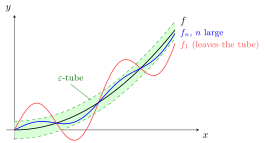
Uniform convergence means that for every , the graph of lies in the -tube around for all sufficiently large . Thus holds for all at once, equivalently .
The difference with pointwise convergence lies only in the order of the quantifiers: pointwise, may depend on both and ; uniformly, depends on alone. The functions on show why this matters. They converge pointwise to the function that is on and at , but for every , so the convergence is not uniform. The limit is discontinuous although every is continuous.
Uniform convergence is exactly the control needed to pass continuity and integrals to the limit, as the Key Results state. The quantity later gets its own name, the uniform norm, and the same idea is used to show that series of functions, such as power series, converge uniformly.
Key Results
- Uniform convergence implies pointwise convergence.
- Uniform convergence preserves boundedness and continuity (uniform limit theorem). On a closed bounded interval it preserves Riemann integrability and allows It does not by itself preserve differentiability. If the are differentiable on an open interval and also converges uniformly there, then is differentiable and . This additional condition is sufficient, not necessary: converges uniformly to the differentiable zero function on , while does not converge.
Examples
- The sequence converges uniformly to on every bounded interval (since ), but only pointwise on
- The functions on converge pointwise, but not uniformly, to because is unbounded near for every (On there is no pointwise limit at all, since )
Prerequisites
Related Concepts
Sources
- Math III: Analysis · Lecture 1
Aliases: converges uniformly, uniformly convergent Symbols: element of, epsilon, infinity, integral, pi, real numbers, subset
Last updated: 27 October 2026 11:52
Uniform ConvergenceInfinite Series of FunctionsFunctionPointwise ConvergenceUniform Norm