Heine-Borel Theorem
Theorem
Let be a subset of the Euclidean space The set is compact if and only if it is both closed and bounded.
Interpretation
A set in Euclidean space is compact exactly when it contains all its limit points and stays within some finite distance from the origin. Closedness keeps the boundary in, boundedness keeps it from running off to infinity. The theorem turns the condition on all open covers into two properties that are easy to check.
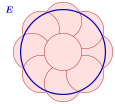
The closed disc is drawn with nine small open discs over it, standing for a finite subcover. Since is closed and bounded, every open cover of can be reduced to finitely many of its sets.
Both conditions are needed, and each failure has a cover to show it. The bounded but not closed set is covered by the open intervals , , and finitely many of them cover only for the largest used. The closed but unbounded set is covered by the intervals , , and finitely many of them miss every point beyond the largest .
The theorem is special to with its usual metric. In every metric space a compact set is closed and bounded, but the converse can fail: with the discrete metric, is closed and bounded but not compact.
Together with the Bolzano-Weierstrass theorem, which makes closed and bounded sets in sequentially compact, the theorem shows that the three properties coincide there. In practice it is how compactness is checked, for instance for the extreme value theorem on compact sets: the triangle is closed and bounded, hence compact.
Key Results
- The continuous image of a compact set is compact. This yields the extreme value theorem.
- Any closed subset of a compact set in is itself compact.
- Finite unions of compact sets are compact. The intersection of any nonempty family of compact subsets of is compact; the intersection itself may be empty.
Examples
- A closed metric ball in the Euclidean space is closed and bounded, so compact.
- Any finite set is closed (finite sets are closed) and bounded, so compact.
Prerequisites
Related Concepts
Sources
- Math III: Analysis · Lecture 9
Symbols: element of, infinity, real numbers, subset
Last updated: 20 October 2026 03:02
Heine-Borel TheoremCompact SetBounded Set in a Metric SpaceBolzano Weierstrass Theorem