Strongly Equivalent Metrics
Definition
Let be a metric space. The metrics and on (two arbitrary metrics; the subscripts are only labels) are termed strongly equivalent, denoted , if positive constants and exist such that for any ,
Interpretation
Strongly equivalent metrics measure distances on different scales, but the ratio between the two distances is bounded above and below by fixed constants. A distance that is small in one metric is therefore small in the other, uniformly over all pairs of points.
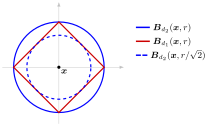
On , the illustrated Euclidean and taxicab distances satisfy . In the figure, the diamond of points with -distance less than from lies inside the disc of points with -distance less than , and it contains the smaller disc of -radius . Being close to in one metric therefore forces being close in the other, so the two metrics have the same convergent sequences.
The constants and must work for all at once. Because of this uniformity, strongly equivalent metrics share more than convergent sequences: they have the same Cauchy sequences, so one of them is complete if and only if the other is. For metrics that come from norms, strong equivalence is the same as equivalence of the norms, so any two -metrics on are strongly equivalent.
Having the same convergent sequences is not enough for strong equivalence. On , the metric has the same convergent sequences as , but the ratio is unbounded near , and is Cauchy for and not for , since . Such metrics return later in the course as topologically equivalent metrics.
Key Results
- The strong equivalence relation possesses symmetry ( if and only if ), reflexivity () and transitivity (if and , then ).
- Strongly equivalent metrics induce the same notion of convergence.
Examples
- Any two -metrics on are strongly equivalent.
- The discrete metric, , is not strongly equivalent to any of the -metrics.
Prerequisites
Related Concepts
- Equivalent Norms
- Topologically Equivalent Metrics
- Convergence in a Metric Space
- -norm and -metric
- Discrete Metric
Sources
- Math III: Analysis · Lecture 4
Aliases: Lipschitz equivalent metrics, strongly equivalent Symbols: element of, infinity, pi, real numbers, square root
Last updated: 20 October 2026 03:02
Strongly Equivalent MetricsMetric and Metric SpaceEquivalent NormsTopologically Equivalent MetricsConvergence in a Metric Spacep-norm and p-metricDiscrete Metric