Discrete Metric
Definition
Consider the space with its elements and . We define a discrete metric as:
Although the example uses the Real Coordinate Space , the same formula works on any set. It satisfies the Metric and Metric Space axioms: in particular, if , at least one of and holds, giving the triangle inequality.
Interpretation
The discrete metric is the simplest possible distance: distinct points are always exactly apart, and a point is from itself. It treats every pair of different points as equally far, so it only records whether two points are equal.
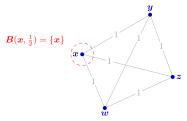
Every line between two of the four points has length , however the points are drawn. The red circle of radius around contains no other point: under this metric no point has neighbours closer than .
The discrete metric is mainly a test case: it satisfies every metric axiom, yet little of the behaviour of the Euclidean distance carries over. Since forces , a sequence converges only if it is eventually constant. In the same way, forces , so every Cauchy sequence is eventually constant and the space is complete.
The metric also shows that a metric need not come from a norm: a norm would give , while for . Points that are very close in the Euclidean distance are at discrete distance , so no bound holds, which is why the discrete metric is not strongly equivalent to the -metrics.
The discrete metric returns later in the course as a standard counterexample for open and closed sets.
Key Results
- The discrete metric is not strongly equivalent to any of the -metrics.
Examples
- since .
Prerequisites
Related Concepts
Sources
- Math III: Analysis · Lecture 4
Symbols: real numbers
Last updated: 20 October 2026 03:02
Discrete MetricReal Coordinate SpaceMetric and Metric Spacep-norm and p-metricStrongly Equivalent MetricsConvergence in a Metric Space