Taylor's Theorem
Theorem
Let be an integer and assume that the function is -times differentiable (not necessarily real analytic) at There exists a function such that and
where is called the Peano form of the remainder.
Interpretation
Taylor's theorem says that a function which is times differentiable at is, near , a polynomial plus a small error. The polynomial is the Taylor polynomial of order , and the error is small even compared with the last term kept, because the factor tends to as .
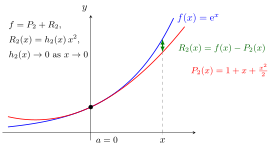
The figure takes and , with the second-order Taylor polynomial . The two curves touch at ; at the marked point the green arrow is the remainder . As moves towards this gap shrinks faster than , which is the statement .
The hypothesis is weak: only has to exist, and need not be smooth or real analytic. In return, the conclusion only concerns the limit , not the error at a fixed . The order of the expansion is limited by the number of derivatives: has and with , but does not exist and has no expansion , since has no limit at .
In little- notation, the theorem turns limits of quotients into a comparison of leading terms, an alternative to L'Hôpital's rule: from one reads off as .
The theorem returns for functions of several variables in Math IV, in multivariate Taylor approximations.
Key Results
- Using the little- notation, the statement in Taylor's theorem reads as as In this case, we have the -th order Taylor expansion, whose polynomial part is the Taylor polynomial :
Examples
- , where .
- , where , for .
Prerequisites
Related Concepts
Sources
- Math III: Analysis · Lecture 3
Aliases: Taylor's formula, Taylor’s formula Keywords: k-th order Taylor expansion, remainder term Symbols: infinity, real numbers, sum
Last updated: 22 October 2026 19:04
Taylor's TheoremTaylor PolynomialHigher-Order DerivativeTaylor SeriesBig-O and Little-o NotationsL'Hôpital's Rule