Multivariate Taylor Approximations
Definition
Let be sufficiently smooth near and let be a small displacement. The first-order Taylor approximation is
If is near , the second-order approximation is
The first correction uses local slope, and the second correction uses local curvature.
Interpretation
Taylor approximations replace a complicated function near a point by simpler local information. The linear term estimates the immediate change, and the quadratic term corrects for bending.
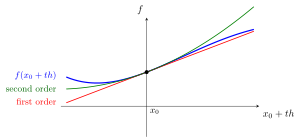
The figure follows the line for a fixed direction . Its first-order approximation is ; the second-order approximation adds . As , the errors are under differentiability and under the hypothesis.
The Jacobian of a scalar-valued function is a row matrix, so multiplying it by the displacement gives the first-order scalar change. The Hessian contributes the quadratic correction when the hypothesis holds.
Key Results
- For a real-valued function, .
- If is , then the Hessian is symmetric and the second-order term is a quadratic form.
- At a critical point, the quadratic term is the first potentially nonzero correction. It may also vanish, in which case higher-order information is needed.
Examples
- For at , the second-order approximation is exact.
- For at , the second-order approximation is .
Prerequisites
Related Concepts
Sources
- Math IV: Multivariate Calculus · Week 2, Lecture 1
Aliases: multivariate Taylor expansion Keywords: linear approximation in Rn, second-order approximation, quadratic approximation, Taylor approximation with Hessian Symbols: nabla gradient, real numbers
Last updated: 27 October 2026 11:52
Multivariate Taylor ApproximationsJacobian MatrixHessian MatrixQuadratic FormHigher-Order Partial Derivative