Method of Lagrange for Constrained Minimization
Theorem
Let be open, and let the objective and all constraint functions be continuously differentiable on . For
the course convention writes the inequality part as and defines
If is a local constrained minimizer, then either nondegenerate constraint qualification (NDCQ) fails or there are multipliers satisfying
Interpretation
For minimization, the inequality is written so the same nonnegative multiplier convention can be used. The resulting conditions are still only a candidate filter.
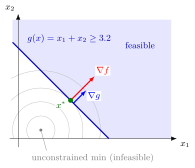
In the illustrated minimization problem, and the nonnegative multipliers satisfy and . At the boundary optimum, the gradient points into the feasible side. Equivalently, one can maximize under the same constraints.
The mixed-constraint method separates equality multipliers from signed inequality multipliers. Passing from maximization to minimization requires the residual convention written above; multiplier signs cannot be copied without checking that convention.
Key Results
- The sign of the inequality term in the Lagrangian depends on the feasible side of the constraint.
- Nonbinding inequalities have zero multipliers.
- Equality multipliers remain unrestricted.
Examples
- For subject to , use .
- If at a local minimizer subject to , complementary slackness forces the multiplier on that constraint to be zero.
Prerequisites
Related Concepts
Sources
- Math IV: Multivariate Calculus · Week 5, Lecture 2
Aliases: inequality minimization Lagrangian Keywords: minimization FONC, Lagrange method for minimization Symbols: element of, lambda, mu, nabla gradient, real numbers, subset, sum
Last updated: 22 October 2026 19:04
Method of Lagrange for Constrained MinimizationMethod of Lagrange for Mixed ConstraintsLagrangian FunctionLagrange MultiplierSecond-Order Sufficient Conditions for Constrained OptimizationGeneral Method of Lagrange