Restriction of a Function
Definition
Let be a function and let . The restriction of to is the function
Only the domain is changed; the rule used to compute the value is the same.
Interpretation
A restriction keeps the rule of and only shrinks its domain to a subset . This is the formal step behind optimizing a function subject to constraints: the objective stays the same, only the admissible inputs change.
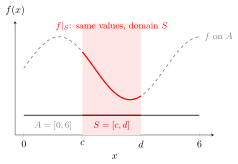
The dashed curve is on ; the red piece over is the graph of , with the same values and a smaller domain. Its largest value is at the left endpoint , where itself is decreasing and has no local maximum. The extrema of are the constrained extrema of , and they can sit where has none.
Other properties change with the domain too: may be injective or bounded when is not: is injective on (see the Examples) and bounded on , but neither on . In the same way, is defined as the inverse of the restriction of to (inverse trigonometric functions), and the multivariable inverse function theorem inverts on a small neighbourhood . For an equality constraint , the restricted domain is a level set of .
A common slip is to look for the extrema of among the stationary points of . On the unit circle, is largest at , although its gradient is never zero.
Key Results
- The restricted function can have extrema that the unrestricted function does not have.
- A constraint set often defines the domain of the restricted objective.
- Properties such as injectivity can change after restriction.
Examples
- The function restricted to the circle becomes an objective on that circle only.
- The function is not injective on , but its restriction to is injective.
Prerequisites
Related Concepts
- Method of Lagrange for Equality Constraints
- Quadratic Form on a Constraint Set
- Global Maximum and Minimum on
Sources
- Math IV: Multivariate Calculus · Week 3, Lecture 1
Aliases: restriction to a set Keywords: function restriction, restricted function Symbols: infinity, pi, real numbers, square root, subset
Last updated: 27 October 2026 11:52
Restriction of a FunctionFunctionLevel Set and Level CurveMethod of Lagrange for Equality ConstraintsQuadratic Form on a Constraint SetGlobal Maximum and Minimum on \(\mathbb{R}^n\)