Envelope Theorem for Constrained Optimization
Theorem
In a parametric problem, the value function is the optimized objective value
where is an optimizer. For equality constraints, define
If smooth optimizer and multiplier functions satisfy the first-order conditions, then
For mixed constraints, the same formula holds with the Lagrangian including the binding inequalities and equality constraints, provided the relevant bordered Hessian is nonsingular and the active set is smooth. In the special equality case with independent of , the multiplier is the shadow price:
Interpretation
The envelope theorem computes how the best attainable value changes when a parameter changes. It avoids separately differentiating every movement of the optimizer.
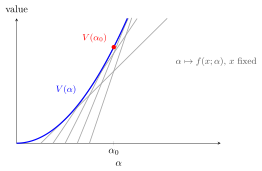
In the illustrated example, the feasible choices do not depend on , and the value function (written in the theorem above) is the upper envelope of the grey curves obtained by fixing . At , it touches the curve for and shares its slope: . The theorem above gives the corresponding formula when the constraints depend on the parameter.
The equality-constraint Lagrange method supplies the stationarity equations. Applying the implicit function theorem to those equations and the constraints can give locally smooth optimizer and multiplier functions when the relevant bordered Hessian is nonsingular. The chain-rule terms involving optimizer movements then cancel by stationarity and differentiated feasibility.
Key Results
- The value function records the optimum as a function of parameters.
- The envelope derivative is the direct parameter derivative of the Lagrangian at the optimal solution.
- A shadow price is the marginal value of relaxing a constraint in the stated equality-constraint setup.
Examples
- For , the envelope derivative is .
- In utility maximization with income as a parameter, the multiplier on the budget equation measures marginal utility of income.
Prerequisites
- Lagrangian Function
- Method of Lagrange for Equality Constraints
- Implicit Function Theorem
- Bordered Hessian Matrix
Related Concepts
Sources
- Math IV: Multivariate Calculus · Week 6, Lecture 1
- Math IV: Multivariate Calculus · Week 7, Lecture 1
Keywords: envelope theorem, equality envelope theorem, mixed-constraint envelope theorem, value function, shadow price Symbols: alpha, gamma, mu, partial, sum
Last updated: 26 October 2026 00:09
Envelope Theorem for Constrained OptimizationLagrangian FunctionMethod of Lagrange for Equality ConstraintsImplicit Function TheoremBordered Hessian MatrixLagrange MultiplierMethod of Lagrange for Mixed Constraints