Complementary Slackness
Definition
For an inequality constraint written as (for example for a constraint ) with multiplier , complementary slackness is the condition
Equivalently, either the constraint is binding or its multiplier is zero.
Interpretation
Complementary slackness says that a constraint can matter through its multiplier only when it is actually tight.
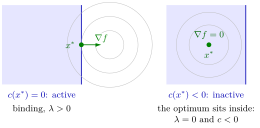
On the left, the binding constraint holds back the maximum, with , , and . On the right, the optimum lies in the interior and the multiplier is zero. The grey curves are objective level sets and the blue region is feasible.
The inequality fixes the sign of the slack. A strictly negative constraint value forces its multiplier to zero because their product must vanish; equality permits a nonzero multiplier.
Key Results
- If , then .
- If , then .
- The condition is part of the Kuhn-Tucker system for inequality-constrained optimization.
Examples
- If is written as and the optimum has , then the multiplier must be .
- If a multiplier for is positive, then the optimum must satisfy .
Prerequisites
Related Concepts
- Kuhn-Tucker Conditions with Nonnegativity Constraints
- Method of Lagrange for Inequality-Constrained Maximization
- Nonnegativity Constraint
- Slack Variable
Sources
- Math IV: Multivariate Calculus · Week 5, Lecture 1
Aliases: complementary slackness condition, kt slackness, complementarity condition Keywords: slackness condition Symbols: lambda, nabla gradient
Last updated: 17 October 2026 21:53
Complementary SlacknessBinding and Nonbinding ConstraintsLagrange MultiplierInequalityKuhn-Tucker Conditions with Nonnegativity ConstraintsMethod of Lagrange for Inequality-Constrained MaximizationNonnegativity ConstraintSlack Variable