Slack Variable
Definition
For a constraint , a slack variable converts it into
Thus measures the unused allowance in the inequality.
Interpretation
A slack variable measures how much of an allowance is left unused: the gap between the limit and the amount actually used. Adding it turns the inequality into an equation, the form the simplex method works with, without changing which decisions are allowed.
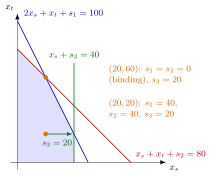
Each constraint line of the Giapetto model carries its slack equation. At the interior point all three slacks are positive: , , . At the optimal corner the first two constraints are binding, , while .
The nonnegativity constraint carries the direction of the original inequality: a negative slack would put the point outside the feasible region. With nonnegative right-hand sides the slacks give the first basic feasible solution, at the origin. A constraint needs a surplus variable, subtracted instead.
Key Results
- A zero slack means the constraint is binding at that solution.
- The introduced slack has zero coefficient in the original objective.
- With nonnegative right-hand sides, slack variables can form an initial feasible basis.
Examples
- becomes .
- At this slack equals zero.
Prerequisites
Related Concepts
Sources
- OR Modelling · Week 2
Symbols: sum
Last updated: 20 October 2026 03:02
Slack VariableAugmented FormShadow Price in Linear ProgrammingConstraintNonnegativity ConstraintSurplus Variable