Parity Constraint
Definition
For three binary decisions , requiring an even number of yes decisions is equivalent to
The sum can therefore be 0 or 2, the only even values possible for three binary decisions.
Interpretation
The parity constraint counts yes decisions and requires the count to be even. Three binary decisions sum to at most , so the even counts are and , and the auxiliary variable in produces exactly these.
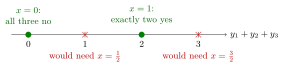
The number line shows the four possible counts. The even ones are reached with (all three no) and (exactly two yes); the odd counts and would need or , which are not allowed.
The parity condition comes from being an integer. If is relaxed to a continuous variable with , the odd count becomes feasible with , so evenness is no longer enforced. The bound still excludes count , which would need . If those bounds are also removed, every count can be matched by . An odd count is required by writing , and more decisions need a larger integer range for .
Key Results
- When , all three decisions are no.
- When , exactly two decisions are yes.
- Allowing to be continuous would remove the parity restriction.
Examples
- is allowed with .
- is excluded because it would require .
Prerequisites
Related Concepts
Sources
- OR Modelling · Week 3
Symbols: element of
Last updated: 27 October 2026 11:52
Parity ConstraintBinary VariableFinite-Value ConstraintContingent Decisions