Giapetto Production Model
Definition
The Giapetto production model chooses wooden soldier production and train production to maximize profit. With the data in the course, the LP is
Interpretation
The Giapetto model is a complete small production-planning LP: two products compete for two shared workshop resources, and one of them also faces a sales limit.
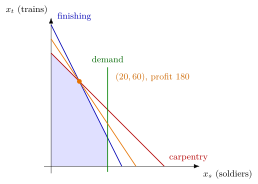
The three constraint lines cut the first quadrant down to a pentagon of possible plans. The orange profit line touches the region only at the corner , where the finishing and carpentry lines cross; every line with a larger profit misses the region, so is the best plan.
Each number has a practical reading. The objective coefficients and are the profits per soldier and per train. In the coefficients are finishing hours per toy and is the number of finishing hours available; does the same for carpentry, with one hour per toy. The limit restricts soldiers only. This is linear program formulation at work: data become model parameters, and the choices become decision variables.
The optimum is not obvious from the profits alone. Soldiers earn more per unit, yet the best plan makes three times as many trains as soldiers. Making as many soldiers as allowed, , uses finishing hours, so at most trains remain possible and the profit is . Per finishing hour a soldier earns and a train , so the limited finishing time favours trains.
Key Results
- The profit contribution is 3 per soldier and 2 per train.
- Finishing and carpentry constrain the two products jointly.
- The soldier demand limit constrains only .
Examples
At the illustrated plan , the finishing and carpentry restrictions bind, while the soldier-demand restriction has slack because .
- Producing 20 soldiers and 60 trains uses 100 finishing hours and 80 carpentry hours.
- Producing 40 soldiers and 40 trains violates the finishing limit because it needs 120 hours.
Prerequisites
Related Concepts
Sources
- OR Modelling · Week 1
Aliases: Giapetto problem, Giapetto's Woodcarving Keywords: Giapetto's wood carving
Last updated: 20 October 2026 03:02
Giapetto Production ModelLinear ProgrammingLinear Program FormulationDiet ProblemGraphical Method