K-Out-of-N Constraints
Definition
To require at least of inequalities , introduce binary relaxation indicators and impose
Here and must validly relax each marked inequality. The video's equality gives the same allowed values when such relaxation is valid.
Interpretation
The K-out-of-N construction requires enough conditions from a list to hold, without saying in advance which ones. Each indicator can release one inequality, at most inequalities may be released, and so at least remain enforced. A released inequality is allowed to hold as well.
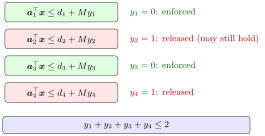
Here and . The switches and equal , so the second and fourth inequalities are released, while keeps the first and third enforced. The bound forbids releasing a third one, so at least two of the four inequalities always hold.
Each part has one job. With the term disappears and is enforced; with the right-hand side grows by , which must be large enough to impose no restriction on the relevant values of . For and this is the either-or construction, where the two indicators are and . The counting constraint is the same kind of bound on a sum of binary variables as in mutually exclusive decisions.
Mind the direction: means that inequality is released, not that it holds. Read the other way round, would seem to say that at most inequalities hold, the opposite of what is intended. The construction also does not make exactly inequalities true, since a released inequality may still be satisfied.
Key Results
- The formulation does not require exactly original inequalities to be true.
- The practice solution uses the inequality version; the video uses equality.
- For , no constraint may be relaxed.
Examples
The figure sets , : the binary bound allows at most two released inequalities, leaving at least two enforced. The constant must be large enough to remove unintended restrictions from every released inequality.
- At least two of four constraints can be enforced using .
- At least two of three constraints leave at most one relaxation indicator equal to 1.
Prerequisites
Related Concepts
Sources
- OR Modelling · Week 3
Symbols: sum
Last updated: 20 October 2026 03:02
K-Out-of-N ConstraintsEither-Or ConstraintsFinite-Value ConstraintNonconvex Region Modelling