Kruskal Method
Definition
The Kruskal method constructs a minimum spanning tree by starting with no selected edges and repeatedly choosing a shortest unselected edge that does not create a cycle with the already selected edges. Stop once the selected edges connect all vertices.
Interpretation
The Kruskal method builds a minimum spanning tree by always taking the shortest edge that is still allowed. The selected edges may initially form several separate pieces; the method joins those pieces while avoiding unnecessary loops.
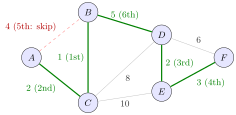
The labels give the order in which the edges are considered, by increasing length. The first four, , , and , are accepted and form two pieces, and . The fifth edge, , is skipped because and are already joined through . The sixth, , joins the two pieces, and with edges the tree is complete, of total length 13.
The test "does this edge create a cycle?" is the same as asking whether its two endpoints already lie in the same piece. An edge between two different pieces merges them; an edge inside one piece adds nothing to connectedness and would close a cycle. Once edges are accepted, all vertices lie in one piece, so the remaining edges need not be inspected.
Always taking the cheapest available step is often only a heuristic, without a guarantee of optimality; for spanning trees it is exact, which is why the method always ends with a minimum spanning tree. The Dijkstra-Prim method instead grows a single connected tree from a start vertex. Both reach the same minimum total length, possibly with different trees when there are ties.
Key Results
- Equivalently, inspect edges in nondecreasing order and reject any that create a cycle.
- For vertices, a completed tree has selected edges.
- Equal-length eligible edges may be chosen in any order.
Examples
For the figure, the sorted weights are . Accept , reject because it closes , then accept . These edges have total length 13.
- If A-B and B-C are already selected, adding A-C would create a cycle and must be rejected.
- Week 4 practice 3 has three independent binary tie choices, giving minimum trees.
Prerequisites
Related Concepts
Sources
- OR Modelling · Week 4
Aliases: Kruskal's algorithm
Last updated: 20 October 2026 03:02
Kruskal MethodMinimum Spanning TreeCycleDijkstra-Prim Method