Simplex Optimality Test
Proposition
For a maximization LP with a feasible canonical tableau written as , if for every nonbasic variable, the current basic feasible solution is optimal. Here is the nonbasic index set and every variable is nonnegative.
Interpretation
The optimality test tells the simplex method when to stop. It checks whether increasing any nonbasic variable from zero could raise ; if none could, the current basic feasible solution is optimal, and the tableau itself is the proof.
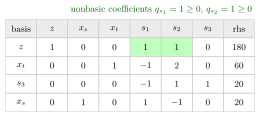
In the final Giapetto tableau the nonbasic variables are the slacks and , both with objective-row coefficient . Read as an equation, the row says . Since slacks are nonnegative, no feasible solution has , and the current solution with reaches this bound.
Each condition has a role. The objective row comes from the original equations by row operations, so it holds for every feasible solution, not only the current one; this turns a sign check into a proof. Canonical form makes the row express through the nonbasic variables only, so is the current value and is the effect of increasing alone. Feasibility is needed because the row only gives the bound , and this bound is the optimum only because a feasible point attains it.
With the objective on the left, means that falls by per unit of . A negative therefore signals possible improvement, which is why the entering variable rule looks for the most negative coefficient. A coefficient means could increase without changing , which often points to multiple optimal solutions.
Key Results
- The sign test depends on the course objective-row convention.
- Feasibility and canonical form are required before applying the test.
- A negative coefficient calls for further simplex analysis; degeneracy means it does not alone prove that a strictly better feasible vector exists.
Examples
In the figure, and certify . Setting both nonbasic slacks to zero gives , , , attaining 180. A zero nonbasic objective coefficient can indicate an alternative optimum, but a distinct solution requires a positive feasible movement; a degenerate zero-length pivot is insufficient.
- proves .
- still has a negative coefficient to investigate.
Prerequisites
Related Concepts
Sources
- OR Modelling · Week 2
Aliases: optimality test Symbols: element of, sum
Last updated: 20 October 2026 03:02
Simplex Optimality TestSimplex TableauBasic Feasible SolutionEntering Variable RuleMultiple Optimal Solutions