Optimal Solution
Definition
For a minimization problem with feasible set , a feasible vector is an optimal solution if
For maximization the inequality is reversed. The number is the optimal value.
Interpretation
Optimality compares a feasible decision with every other allowed decision. An optimal solution is at least as good as each of them; it need not be strictly better, so several equally good decisions may exist.
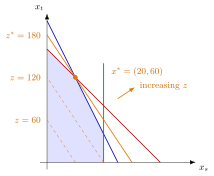
For the dashed lines and cross the feasible region, so better plans exist. The line is the last one in the direction of increasing that still meets the region, and it touches only at : this point is the optimal solution, and is the optimal value.
Both parts of the Definition matter: must itself be feasible, and the inequality must hold for every , not only for the points tried so far. An optimum need not exist, since a model may have no feasible solution or an objective that improves without limit, and need not be unique: when an objective line lies along an edge of the region, every point of that edge is optimal.
Key Results
- A model may have no feasible solution or no finite optimum.
- The optimal value and the vector attaining it are different objects.
- An optimum is relative to the specified objective, constraints, and input data.
Examples
For the illustrated Giapetto objective, the optimal point has value .
- The manufacturing example has , , and .
- The practice LP with objective has optimum and value 14.
Prerequisites
Related Concepts
Sources
- OR Modelling · Week 1
Aliases: Optimum solution, optimal point Symbols: element of
Last updated: 20 October 2026 03:02
Optimal SolutionCorner Point OptimalityHeuristicMinimization-to-Maximization TransformationMultiple Optimal SolutionsRelaxationSensitivity AnalysisFeasible SolutionObjective FunctionOptimization Bounds