Ordering Cycle
Definition
In the constant-demand EOQ setting, the ordering cycle length is the time between consecutive orders. If each order contains units and demand occurs at rate , then
Interpretation
The ordering cycle is the time one batch lasts. With constant demand, a batch of units is used up after time units, and the next order then starts the same pattern again.
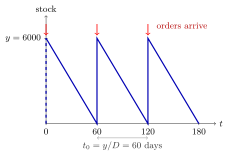
Each tooth of the sawtooth is one cycle: pencils used at per day last days, so orders arrive at days , and , marked by the arrows.
The reciprocal is the number of orders per unit time, which turns the setup cost per order into the rate . Demand and time must use the same unit: per week is per day. The identity also holds with planned backorders, since over a full cycle the batch still equals the cycle's demand. The cycle is the spacing between orders, not the lead time, the delay between placing an order and receiving it.
Key Results
- Orders per unit time equal .
- Cycle length and lead time are different: one measures spacing of orders, the other order-to-receipt delay.
- Convert demand and time consistently.
Examples
- Ordering 22 phones at demand two per day gives an 11-day cycle.
- In the figure, time is measured in days. Ordering pencils at demand per day gives a -day cycle and orders per day.
Prerequisites
Related Concepts
Sources
- OR Modelling · Week 5
Aliases: order cycle, replenishment cycle, inventory cycle Keywords: cycle time
Last updated: 20 October 2026 03:02
Ordering CycleClassical EOQ ModelEffective Lead TimeSetup CostInventory PolicyEconomic Order Quantity