Simplex Method
Definition
The simplex method solves an LP by moving between basic feasible solutions through basis exchanges. In the course's maximization tableau convention, start with a feasible basis, test the objective row (optimality test), select an improving entering variable, apply the minimum-ratio test to select a leaving variable, pivot, and repeat until optimality or unboundedness is established.
Interpretation
The simplex method finds an optimal corner of a linear program without listing all corners. It starts at one corner and repeatedly moves to a neighbouring corner with a better objective value, stopping when no neighbour is better. Algebraically, a corner is a basic feasible solution and a move is a pivot of the tableau.
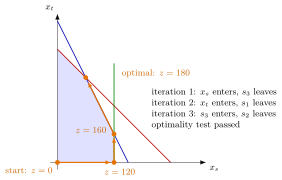
On the Giapetto model, , the path starts at the origin, where the slacks are basic and . Each arrow runs along an edge of the feasible region to an adjacent corner: with , with , and with , where the optimality test is passed. The corner is never visited.
The entering variable rule picks a nonbasic variable whose increase improves ; the minimum-ratio test determines how far it can increase before a basic variable would turn negative, and that variable leaves. If no variable improves , the solution is optimal; if an improving variable can increase without limit, the LP is unbounded. Searching corners suffices because a finite optimum is always attained at some corner (corner-point optimality).
The method needs a feasible starting basis; when none is obvious, as with or constraints, the two-phase method finds one. A pivot never lowers in a maximization, but with step length zero it changes the basis without moving the point, a case called degeneracy.
Key Results
- The elementary starting form uses equality constraints, nonnegative right-hand sides, and nonnegative variables.
- A slack basis starts the method for constraints with nonnegative right-hand sides.
- The two-phase method supplies a feasible basis when one is not immediately available.
- Degenerate pivots can change the basis without moving the decision vector.
Examples
For maximization, a feasible pivot does not decrease the objective. Degenerate pivots may leave it unchanged; an anti-cycling rule is needed to guarantee termination rather than relying only on the finite number of bases.
- The two-variable example visits , , and , with values 0, 15, and 17.
- The three-variable example ends at with value 33.
Prerequisites
Related Concepts
Sources
- OR Modelling · Week 2
Aliases: simplex algorithm, primal simplex method
Last updated: 20 October 2026 03:02
Simplex MethodTwo-Phase MethodLinear ProgrammingBasic Feasible SolutionSimplex TableauSimplex Pivot