Rounding Heuristic
Definition
A rounding heuristic solves an integer program's LP relaxation and converts fractional variable values to nearby integers. The rounded vector is only a candidate: all original constraints must be checked before accepting it as a feasible solution.
Interpretation
The rounding heuristic is the quickest way from an LP relaxation to an integer candidate: take the relaxed optimum and replace each fractional value by a nearby integer. The result comes with no guarantee: coupled constraints can make the nearest rounded decisions infeasible or substantially worse than an integer optimum.
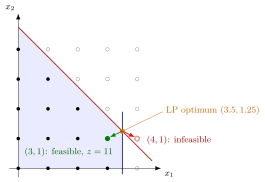
The LP optimum has two natural roundings. Rounding up gives , which violates and ; rounding it down gives , which is feasible with . Here is even the integer optimum, but that is luck rather than a property of rounding.
Rounding fails because the constraints couple the variables, while rounding treats each coordinate on its own. An equality shows this most clearly: if and the relaxation gives , rounding both values up or both down breaks the equality, and only a mixed choice such as works. This is why the method is a heuristic and why every candidate must be checked against all original constraints. Rounding is most reasonable for large quantities, where a change of less than one unit is small compared with the values.
A feasible rounded point is still useful. Its value is a bound from the feasible side, so together with the LP value it encloses the optimum, here by the optimization bounds, and it can serve as a first incumbent in branch-and-bound.
Key Results
- Rounding up can violate resource upper bounds.
- Rounding down can violate minimum requirements or equalities.
- Even a feasible rounded solution need not be optimal.
- The video's numerical rounding illustration has inconsistent written constraints and a plotted feasible region; its claimed optimum is not used here.
Examples
- Rounding upward to violates because the left-hand side is 14.
- The nearby vector satisfies that capacity inequality, but its objective value alone does not prove optimality.
Prerequisites
Related Concepts
Sources
- OR Modelling · Week 3
Last updated: 20 October 2026 03:02
Rounding HeuristicLP RelaxationHeuristicGraphical Integer ProgrammingBranch-and-Bound