Negative RHS Transformation
Definition
The negative right-hand-side transformation multiplies an entire constraint by when its right-hand side is negative. An inequality reverses direction; an equality remains an equality.
Interpretation
Multiplying a whole constraint by rewrites it without changing which points satisfy it. The elementary simplex starting construction needs nonnegative right-hand sides, and this transformation provides them while keeping the same feasible decisions.
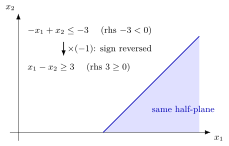
The shaded half-plane is described by both forms: a point satisfies exactly when it satisfies ; for example, gives and .
Multiplying both sides of an inequality by a negative number reverses its direction, so becomes and every coefficient changes sign. Nonnegative right-hand sides matter because the starting solution sets the original variables to zero, so each slack starts at its right-hand side; with this would give . After the transformation, receives a surplus and an artificial variable instead.
Changing only the sign of the right-hand side turns into , a different half-plane: the origin satisfies the new constraint but not the original one.
Key Results
- Change every coefficient and the right-hand side.
- A constraint can become a constraint and consequently require a surplus and an artificial variable.
- Changing only the right-hand side would change the problem.
Examples
- becomes .
- becomes .
Prerequisites
- Constraint
- Inequality manipulation
Related Concepts
Sources
- OR Modelling · Week 2
Last updated: 20 October 2026 03:02
Negative RHS TransformationConstraintSurplus VariableArtificial Variable