Weibull Demand Distribution
Definition
The Weibull demand distribution in the exercise has shape , scale , and nonnegative support. Its CDF and density are given by
The CDF is for . The density formula is stated for : as , it tends to if , to if , and to if . A density's assigned value at the single point does not change the distribution.
For the newsvendor critical ratio , inversion gives
Interpretation
With Weibull demand, the newsvendor answer is still the demand level at which the CDF equals the critical ratio. Because this CDF has an explicit formula, the equation can be solved by hand with a logarithm, without a table: it gives , which is positive because .
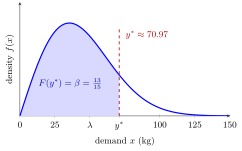
For bananas, and kilograms, and . The density starts at , peaks before and is skewed to the right. The shaded area to the left of is : here , its square root is about , and .
The scale has the units of demand and stretches the distribution: doubling doubles every quantile, including . The shape changes the form of the curve, but for every , so is always the demand level that is not exceeded with probability about . As in the continuous newsvendor rule, the CDF is strictly increasing on , so the order is unique.
A common slip is to write instead of . For the bananas, ; this is the level where equals , not .
Key Results
- Use the given shape and scale parametrization.
- The CDF is zero below zero.
- The scale parameter has the same units as demand.
Examples
- Bananas have , , , , so .
- The optimum is kilograms.
Prerequisites
- Continuous Newsvendor Rule
- Logarithms and cumulative distribution functions
Related Concepts
Sources
- OR Modelling · Week 6
Symbols: beta, infinity, lambda, square root
Last updated: 27 October 2026 11:52
Weibull Demand DistributionContinuous Newsvendor RuleNormal Demand Distribution